

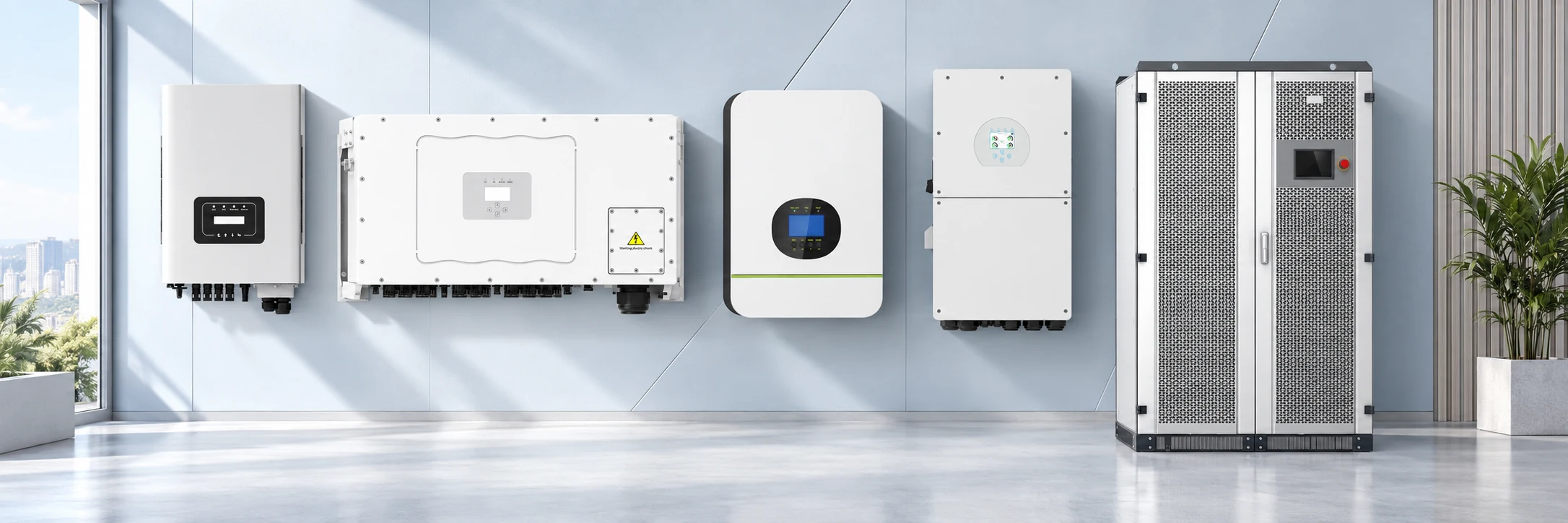
An inverter quote often starts with a power rating: 50 kW, 100 kW or 125 kW. That number matters, but it does not answer the first question. What should the system do when the grid is available—and what should happen when it is not?
For a site that mainly wants to use its own solar generation, a grid-tied inverter may be the straightforward choice. If the project also needs a battery, scheduled charging and discharging, or power for selected loads during an outage, a hybrid design deserves a closer look. The answer comes from the site’s operating requirements, not the largest number on a product label.
Start with the outage question
A grid-tied inverter converts the panels’ DC output to AC for use at the site or export under the local interconnection arrangement. A conventional grid-tied PV system normally disconnects when the utility supply fails. Solar panels on the roof do not, by themselves, mean the building will have power during an outage. The U.S. Department of Energy’s inverter guide explains the inverter’s role in converting and controlling power at the grid connection.
A hybrid system can coordinate PV, a battery, the grid and loads, but its backup behavior depends on the complete design. Ask which circuits will be backed up, how they are isolated from the grid, and what happens during the transfer. A battery and a hybrid inverter should not be treated as a promise to run an entire factory through a blackout. Local interconnection rules and the utility’s requirements also have to be met; NREL’s interconnection resources describe why these rules matter for distributed energy systems.
Do not size the inverter from panel wattage alone
The PV array is rated in DC kilowatts, while the inverter’s output is rated in AC kilowatts. Those numbers do not have to match exactly. For example, a proposed 300 kW DC array with 250 kW of AC inverter capacity has a DC-to-AC ratio of 1.2. That is an illustration, not a recommended setting for every site.
Changing the ratio affects how much solar energy the inverter can deliver at different hours, including whether output is limited at peak conditions. The right comparison is expected annual AC energy and project cost for the actual location, orientation and equipment. NREL’s PVWatts calculator includes DC-to-AC ratio and inverter efficiency as inputs for this kind of estimate. The final string design must also stay within the selected inverter’s DC voltage and current limits.
Check the grid connection before choosing a model
For a commercial site, confirm the available AC voltage and phase, the point of connection, transformer capacity, and any export limit. The local utility or approving authority may impose equipment and protection requirements. A 100 kW inverter is not automatically suitable because the planned array is close to 100 kW; the site’s connection and the exact model datasheet still have to agree.
NOVASUN lists 50–125 kW commercial grid-tied inverters in several power ratings. The published product page is a starting point for comparison, not a substitute for checking the selected model’s DC inputs, AC output and local approval requirements. For projects that need battery integration, the 30/50/100/120/150 kW commercial hybrid inverter range offers a different system approach. Compare the actual model and battery configuration rather than assuming every hybrid inverter has the same backup functions.
If backup is the goal, define the loads
List the equipment that must remain on during an outage. Its running power in kW, starting surges and required operating time are separate questions. A short outage affecting lighting and controls is a different design problem from keeping refrigeration or production equipment running for hours. Battery energy in kWh, inverter power in kW, transfer equipment and the site distribution board all matter.
If you are still deciding how much storage is needed, our commercial BESS sizing guide walks through those questions. For a solar-only project, avoid paying for a backup function you will not use. For a site where downtime is costly, do not select a grid-tied solar system and assume storage can be added later without checking the electrical design.
What to send for a useful proposal
Share the site location, recent electricity bills or interval load data, planned PV capacity, grid voltage and phase, and any export restriction. If backup matters, add a list of critical loads and the target runtime. A single-line diagram and photos of the proposed equipment area help the engineering discussion move faster.
With those details, the choice between grid-tied and hybrid becomes a project decision rather than a label comparison. Review the solar inverter range and contact NOVASUN with the site information for a model-specific discussion.